Why cleared paddocks do not finish the job
Drive past rural blocks west of Ballarat or across regional Victoria, NSW, and South Australia before summer and you see the same practical preparation done well: grass slashed low, boundary tracks graded, gutters cleaned out in spring, and woodpiles shifted back from the verandah. All of that matters. It cuts direct flame contact and lowers the radiant heat load when a grass or scrub fire crosses a boundary.
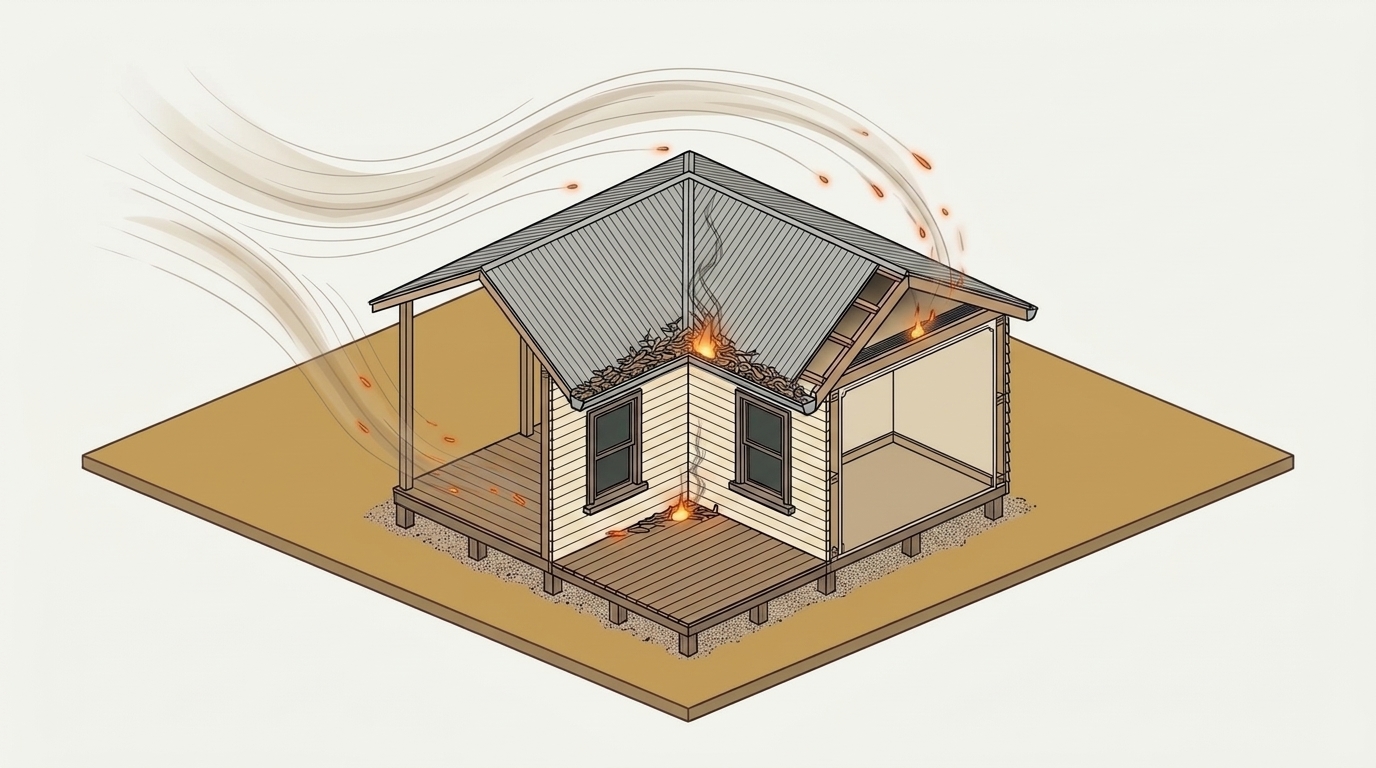
The frustrating part is that houses with well-cleared setbacks still burn down. When you read through the post-fire forensic surveys rather than watching news clips of a roaring wall of flame, a very different failure sequence shows up. Most rural dwellings do not explode the instant the fire front reaches the fence line. They survive the front, then ignite quietly from windborne embers hours later when nobody is there to tip a bucket on a smouldering gutter.
This note is Part 1 of a three-part engineering series documenting the physical constraints Hakea Fire is designed around. Part 1 covers how Australian bushfire homes actually ignite; Part 2 works through rainwater tank hydraulics; Part 3 looks at power, sensing, and communications when mains lines and 4G towers drop.
What the CSIRO and Bushfire CRC surveys actually establish
Across decades of Australian post-bushfire house loss investigations led by CSIRO and the Bushfire CRC, researchers examined surviving physical evidence to separate direct flame contact, radiant heat exposure, and windborne ember ignition. Their landmark reviews documented windborne ember attack as a primary or contributing ignition mechanism in over 85% of destroyed Australian dwellings [1] .
That finding deserves careful reading. It does not mean direct flames or radiant heat are harmless, especially where dense bush sits close to timber framing or untreated glazing. What it does establish is that embers travel well ahead of and well behind the main fire front, turning horizontal surfaces and small sheltered cavities into ignition traps long after the visible flames have moved down the road.
In practice, wind slows down around rooflines, verandahs, valley flashings, eaves, window sills, and sub-floor timber decks. Burning bark ribbons and glowing twigs drop out of the air stream right into those dead zones. A single piece of glowing stringybark sitting against dry eucalypt leaf litter in a gutter can smoulder unnoticed for 30 to 90 minutes before wind fans it into the fascia board.
| Event phase | Typical window | Primary ignition mechanism | Practical implication for property systems |
|---|---|---|---|
| Pre-front approach | 30 to 90 minutes before front | Spotting embers carried downwind ahead of the main fire | Pre-wetting raises surface moisture on gutters, roofs, and decks before embers settle. |
| Main flame front | 5 to 15 minutes at the boundary | Peak radiant heat, convection, and heavy ember density | People must already have left early. Power feeders and exposed poly pipework face maximum thermal stress. |
| Post-front ember storm | 1 to 4+ hours after front passes | Sustained windborne embers landing in gutters, eaves, decks, and sheds | This is where most unprotected, unattended structures ignite. Static water reserves must last hours, not minutes. |
| Residual smoulder | Hours to next morning | Re-ignition from burning fence posts, mulch, or trapped leaf litter | Intermittent surface wetting prevents smouldering embers from developing into sustained structural flame. |
- Typical window
- 30 to 90 minutes before front
- Primary ignition mechanism
- Spotting embers carried downwind ahead of the main fire
- Practical implication for property systems
- Pre-wetting raises surface moisture on gutters, roofs, and decks before embers settle.
- Typical window
- 5 to 15 minutes at the boundary
- Primary ignition mechanism
- Peak radiant heat, convection, and heavy ember density
- Practical implication for property systems
- People must already have left early. Power feeders and exposed poly pipework face maximum thermal stress.
- Typical window
- 1 to 4+ hours after front passes
- Primary ignition mechanism
- Sustained windborne embers landing in gutters, eaves, decks, and sheds
- Practical implication for property systems
- This is where most unprotected, unattended structures ignite. Static water reserves must last hours, not minutes.
- Typical window
- Hours to next morning
- Primary ignition mechanism
- Re-ignition from burning fence posts, mulch, or trapped leaf litter
- Practical implication for property systems
- Intermittent surface wetting prevents smouldering embers from developing into sustained structural flame.
Durations are typical operational ranges for grass and eucalypt woodland fires rather than fixed constants; terrain, wind shifts, and fuel loads vary markedly.
The 77% versus 13% gap, and why staying is not the answer
Earlier CSIRO Sustainable Ecosystems analysis by Wilson and Ferguson (1984), built on in later work by Blanchi and Leonard (2008), quantified how sharply survival odds shift depending on whether small ignitions are put out while they are still small [2] . In surveyed events, unattended houses experienced a loss probability of roughly 77%, compared with roughly 13% where able-bodied defenders actively suppressed spot ignitions around the structure [2] .
Those two numbers create an uncomfortable tension for every rural landholder. They are often cited as proof that active spot-fire suppression works. They are also a trap if read carelessly, because asking families to stay behind on Extreme or Catastrophic Fire Danger Rating days carries lethal personal risk. Fire behaviour shifts faster than road exits stay open.
So the real engineering question is narrower and more honest: if the right human decision on a bad fire day is to leave early, what specific job was an on-site defender actually doing during hours one to four after the front passed? Mostly, they were walking laps around the house keeping gutters, decks, window frames, and shed entries damp so glowing embers died on contact instead of catching timber.
What a post-front system has to get right
Designing hardware around post-front ember physics immediately rules out a lot of shortcuts. A short ten-minute drench before you drive out the gate evaporates quickly in 40°C dry north-westerlies. A system that relies on mains power, town water pressure, or a manual button press over 4G fails at the exact moment power poles burn and mobile tower backup batteries run flat.
Equally, a sprinkler setup built without attention to water volume, non-combustible pipework, and AS 5414-2012 static water principles [3] can empty an entire rainwater tank before the post-front ember shower even peaks. Surface moisture needs to persist across hours, not a single burst.
We do not claim that keeping external surfaces damp stops every fire. Heavy unmitigated fuel sitting hard against timber walls or broken glazing can overwhelm any external spray system. What the CSIRO evidence does suggest is that targeting the multi-hour post-front ember window addresses the failure mode responsible for the overwhelming majority of rural home losses [1] [2] .
Next in the series: the 40-minute water trap
Once you accept that ember defence has to span four or more hours after evacuation, a familiar rural asset runs into hard arithmetic. A 20,000-litre rainwater tank paired with an open 500 L/min petrol fire pump runs dry in 40 minutes. Part 2 works through the tank hydraulics.