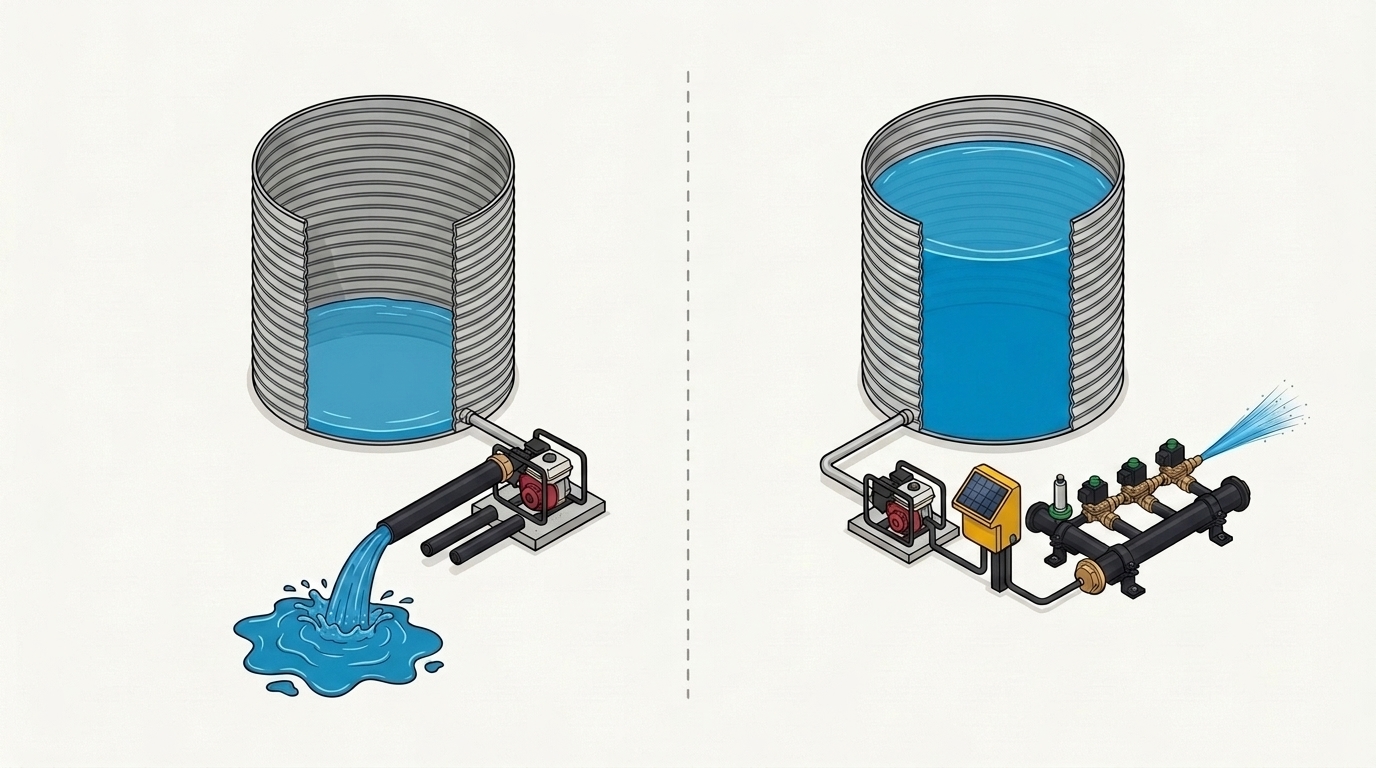
The simple division most DIY sprinkler setups miss
In Part 1 of this series we looked at why post-front ember storms keep threatening rural houses for hours after the flame front moves on [1] . That creates an immediate sizing problem for the rainwater tank already sitting in your yard.
A 20,000-litre poly or corrugated steel tank feels like plenty of water. Most landholders pair it with a standard rural petrol or diesel firefighter pump (Davey, Aussie Pumps, Honda GX, or Yanmar class) capable of moving roughly 450 to 500 litres per minute into an open roof and perimeter sprinkler network. Open every line at once and the arithmetic is blunt: 20,000 litres divided by 500 litres per minute is 40 minutes. At 450 litres per minute it is 44 minutes [4] .
That is the 40-minute trap. If the system kicks in as the fire approaches, the tank hits the bottom outlet right as the main ember shower peaks. You end up with dry steel gutters, a hot pump drawing air, and hours of windborne embers still arriving.
Stretching 20,000 litres past four hours: showing the inputs
Ember suppression does not require a continuous waterfall across every square metre of roof at the same instant. It requires surfaces, leaf gutters, eaves, decks, and shed openings to stay damp so landing embers cool and extinguish rather than drying out and igniting.
Splitting the same property into four independent zones (for example: roof ridge, gutters, garden or deck perimeter, and sheds) changes the hydraulic maths in two ways. First, only one zone opens at a time instead of pressurising all four branches simultaneously, which immediately cuts active discharge from ~450 to 500 L/min down to roughly 115 to 125 L/min per active branch. Second, running each zone on a timed 25% rotational pulse cycle with brief dwell intervals between sprays lowers average system consumption across the whole property to roughly 75 to 80 L/min [4] .
Check the arithmetic directly: 20,000 litres divided by 80 litres per minute is 250 minutes (4 hours 10 minutes). At 75 litres per minute average draw it reaches 266 minutes (4 hours 26 minutes). Every assumption is laid out side by side below so you can adjust the numbers for your own tank size and nozzle schedule.
| Operating regime | Average system draw | Per-zone duty | Modelled 20,000L runtime | Post-front coverage |
|---|---|---|---|---|
| All 4 zones open continuously | 450 to 500 L/min | 100% continuous | 40 to 44 minutes | Depletes before peak post-front ember window finishes. |
| 4-zone sequential rotation (1 active, no dwell) | 115 to 125 L/min | 25% rotational | 2 hrs 40 min to 2 hrs 54 min | Covers early ember wave; still tight in extended wind shifts. |
| 4-zone rotational pulse-wetting (Hakea model) | 75 to 80 L/min | 25% pulse + dwell | 4 hrs 10 min to 4 hrs 26 min | Sustains damp surfaces across a 4+ hour post-front ember window. |
- Average system draw
- 450 to 500 L/min
- Per-zone duty
- 100% continuous
- Modelled 20,000L runtime
- 40 to 44 minutes
- Post-front coverage
- Depletes before peak post-front ember window finishes.
- Average system draw
- 115 to 125 L/min
- Per-zone duty
- 25% rotational
- Modelled 20,000L runtime
- 2 hrs 40 min to 2 hrs 54 min
- Post-front coverage
- Covers early ember wave; still tight in extended wind shifts.
- Average system draw
- 75 to 80 L/min
- Per-zone duty
- 25% pulse + dwell
- Modelled 20,000L runtime
- 4 hrs 10 min to 4 hrs 26 min
- Post-front coverage
- Sustains damp surfaces across a 4+ hour post-front ember window.
Assumes 20,000L dedicated usable fire reserve (excludes dead volume below tank outlet and household consumption). Actual draw depends on nozzle K-factor, head pressure, and dwell timing.
Why 12V brass latching valves beat garden solenoids
If you try to build a four-zone manifold with ordinary 24V AC plastic irrigation solenoids, two problems turn up quickly. Plastic valve bodies soften or deform under radiant heat, and standard normally-closed coils need continuous electrical current the entire time a valve stays open. On an off-grid 12V battery running in thick smoke with zero solar input, continuous coil draw wastes power and cooks coils.
Hakea drives four 25 mm 12V DC brass latching solenoid valves instead. A latching valve needs only a brief milliseconds-long polarity pulse to snap open and another brief pulse to snap closed. While a zone is spraying, holding current is zero. Brass bodies tolerate bushfire heat far better than plastic, and because the valves snap briefly during the automated 1st-of-the-month self-test, diaphragms are exercised every 30 days instead of seizing solid over winter.
Catching a melted pipe before it dumps your roof reserve
Even well-built properties often have one vulnerable branch: an exposed poly garden line near a timber deck, or a riser knocked loose by a falling eucalypt limb in 60 km/h gusts. On an unmonitored manifold, one ruptured branch becomes an open firehose into the paddock. Manifold pressure collapses, roof ridge nozzles drop to a trickle, and the remaining tank drains into the dirt.
Putting a 0 to 1,200 kPa stainless pressure transducer directly on the manifold gives the controller a clear hydraulic signature for every zone. Under normal operation, opening a healthy zone holds working line pressure (say 480 kPa on a typical rural pump setup). If Zone 3 opens and pressure plunges suddenly to 95 kPa, the controller recognises a ruptured branch within seconds, snaps Valve 3 shut, locks out the faulted line, and continues rotating full pressure across Zones 1, 2, and 4 [4] .
At the tank end, a submersible hydrostatic depth sensor pairs with manifold pressure sensing to provide automatic dry-run shutoff. If water finally runs out, the controller kills ignition before a dry pump mechanical seal overheats and wrecks the pump.
Next in the series: when mains power and 4G towers fail
Hydraulic zoning buys four hours of water, but only if the controller still has power, clean triggering, and a way to report status when poles burn and mobile towers drop out. Part 3 covers the off-grid electrical and communications architecture.