The calm-afternoon illusion
If you test a mains-powered 240V pump with a Wi-Fi or standard 4G smart switch on a clear Saturday in October, everything feels effortless. You tap a button in town, the relay clicks, and water hits the roof. It is easy to walk away thinking the problem is solved.
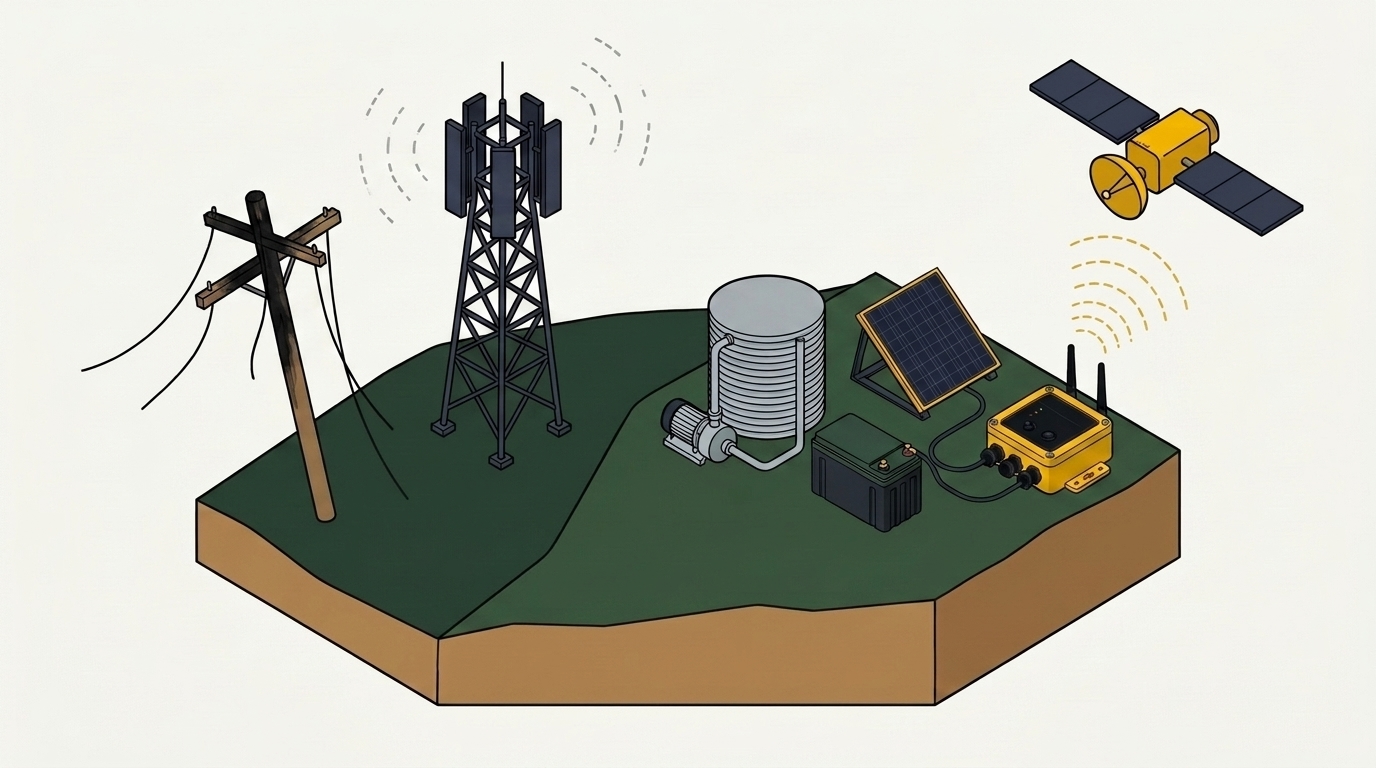
The contradiction is that regional bushfires dismantle the exact infrastructure that test depended on. High winds bring limbs down onto rural distribution feeders, utilities turn off high-risk lines on extreme days, and timber power poles burn. As the 2020 Royal Commission into National Natural Disaster Arrangements documented after the Black Summer fires, power loss is the primary driver of regional telecommunications outages once mobile base-station backup batteries exhaust [5] .
That sequence matters. Mains power drops first. Home Wi-Fi routers and mains-fed pumps stop immediately. Local 4G towers keep running on backup batteries for a limited window while congested emergency traffic spikes, and then they drop too. Any bushfire controller that needs mains power, a home router, or a live 4G tower just to start your pump has failed before the post-front embers arrive [1] .
| Failure point | Mains 240V + Wi-Fi or 4G relay | Hakea Fire off-grid architecture |
|---|---|---|
| Grid power outage | Pump, router, and relay go dead immediately without generator or large inverter. | Dedicated 30W solar panel and isolated 12V 20Ah LiFePO4 battery run independent of mains. |
| Pump starter crank sag | Shared cranking rails can brown out or reboot control electronics mid-crank. | Controller lithium pack is electrically separated from heavy 12V petrol or diesel starter cranks. |
| 4G tower battery flat | Remote trigger fails; property goes silent with zero telemetry. | Local heat probes trigger autonomously; radio switches from 4G LTE-M to direct-to-satellite. |
| Software or cloud outage | Cloud-dependent switch cannot act when server or subscription is unreachable. | 100% local execution, hardware reset timer, and hardwired 65°C mechanical backup switch. |
| 11 months idle in shed | Flat battery or seized valve discovered on a 44°C Total Fire Ban afternoon. | Automated local self-test on the 1st of every month checks battery, valves, starter, and tank depth. |
- Mains 240V + Wi-Fi or 4G relay
- Pump, router, and relay go dead immediately without generator or large inverter.
- Hakea Fire off-grid architecture
- Dedicated 30W solar panel and isolated 12V 20Ah LiFePO4 battery run independent of mains.
- Mains 240V + Wi-Fi or 4G relay
- Shared cranking rails can brown out or reboot control electronics mid-crank.
- Hakea Fire off-grid architecture
- Controller lithium pack is electrically separated from heavy 12V petrol or diesel starter cranks.
- Mains 240V + Wi-Fi or 4G relay
- Remote trigger fails; property goes silent with zero telemetry.
- Hakea Fire off-grid architecture
- Local heat probes trigger autonomously; radio switches from 4G LTE-M to direct-to-satellite.
- Mains 240V + Wi-Fi or 4G relay
- Cloud-dependent switch cannot act when server or subscription is unreachable.
- Hakea Fire off-grid architecture
- 100% local execution, hardware reset timer, and hardwired 65°C mechanical backup switch.
- Mains 240V + Wi-Fi or 4G relay
- Flat battery or seized valve discovered on a 44°C Total Fire Ban afternoon.
- Hakea Fire off-grid architecture
- Automated local self-test on the 1st of every month checks battery, valves, starter, and tank depth.
Why the controller battery never shares a starter crank
A subtle rural engineering mistake is powering control electronics off the same 12V battery that cranks the petrol or diesel fire pump. Anyone who has started a cold Honda GX or Yanmar electric-start engine knows the starter motor pulls a heavy initial current surge. On a slightly aged lead-acid battery, terminal voltage can sag sharply during cranking.
If your controller shares that battery rail, the exact instant it tries to start your pump is the instant its own supply voltage dips, risking a processor brown-out or reboot mid-sequence. Hakea avoids that failure mode by keeping its 30W monocrystalline solar panel and 12V 20Ah LiFePO4 battery pack electrically separated from the pump’s cranking battery, with built-in low-frost and high-temperature charge protection for Australian rural extremes.
Keeping every wire in the kit strictly on extra-low-voltage 12V DC brings a second practical benefit: zero 240V mains wiring, so rural landholders do not need a licensed electrician callout to mount the controller, solar panel, sensors, and 12V latching valve leads. Electrical EMC and RCM compliance are completed ahead of Founding Batch 01 dispatch [3] .
Local triggering without 45°C false alarms, and surviving silicon failure
Autonomous fire triggering has two failure modes pulling in opposite directions: triggering falsely on a blistering 45°C summer afternoon (emptying your tank before any fire exists), or failing to trigger when real fire heat arrives.
To reject midday roof sun, Hakea uses dual shaded mineral-insulated radiant-heat probes rather than an exposed bare temperature sensor. Local firmware tracks sharp fire-front radiant heat spikes relative to ambient air temperature, alongside a 3-attempt crank cycle, petrol auto-choke drive, manifold breach shutoff, and dry-run protection.
Even so, good hardware engineering assumes software can still hang. Inside the IP66 UV-stabilised powder-coated die-cast aluminium enclosure sits a dedicated hardware reset timer plus a hardwired, thermally shielded 65°C mechanical backup switch. Even if every digital processor failed, that mechanical switch triggers pump start directly with zero software in the loop.
Direct-to-satellite failover, and fixing the 11-month neglect problem
For everyday readiness reports and remote pre-wetting, Hakea uses 4G LTE-M. When regional towers go dark, the radio switches automatically to narrowband direct-to-satellite failover through external IP67 bulkhead antennas. That avoids running a power-hungry Starlink dish off an inverter just to move kilobytes of sensor telemetry and start commands.
The quietest failure mode on rural properties, though, has nothing to do with towers or radios. It is neglect. Fire pumps and valves sit idle for eleven months of the year. The worst afternoon to find a flat cranking battery, a seized brass valve, or a tank that dropped to 35% over a dry spell is on a 44°C Total Fire Ban day.
That is why every Hakea pod runs an automated local self-test on the 1st of each month. Without burning petrol or flooding gutters, it load-tests the lithium pack, clicks all four brass valves briefly so they never jam over winter, verifies starter circuit continuity, and reads hydrostatic tank depth. If everything passes, you get one calm summary and the app leaves you alone for the other 29 days.
Where the engineering stands today
Hakea Fire is currently completing field testing and RCM/EMC compliance in Snake Valley, Victoria ahead of Founding Batch 01 (50 units targeting Spring 2026 across regional VIC, NSW, and SA). If you have an existing tank and fire pump and want to check whether your specific setup fits, you can review the full kit boundary or write directly.